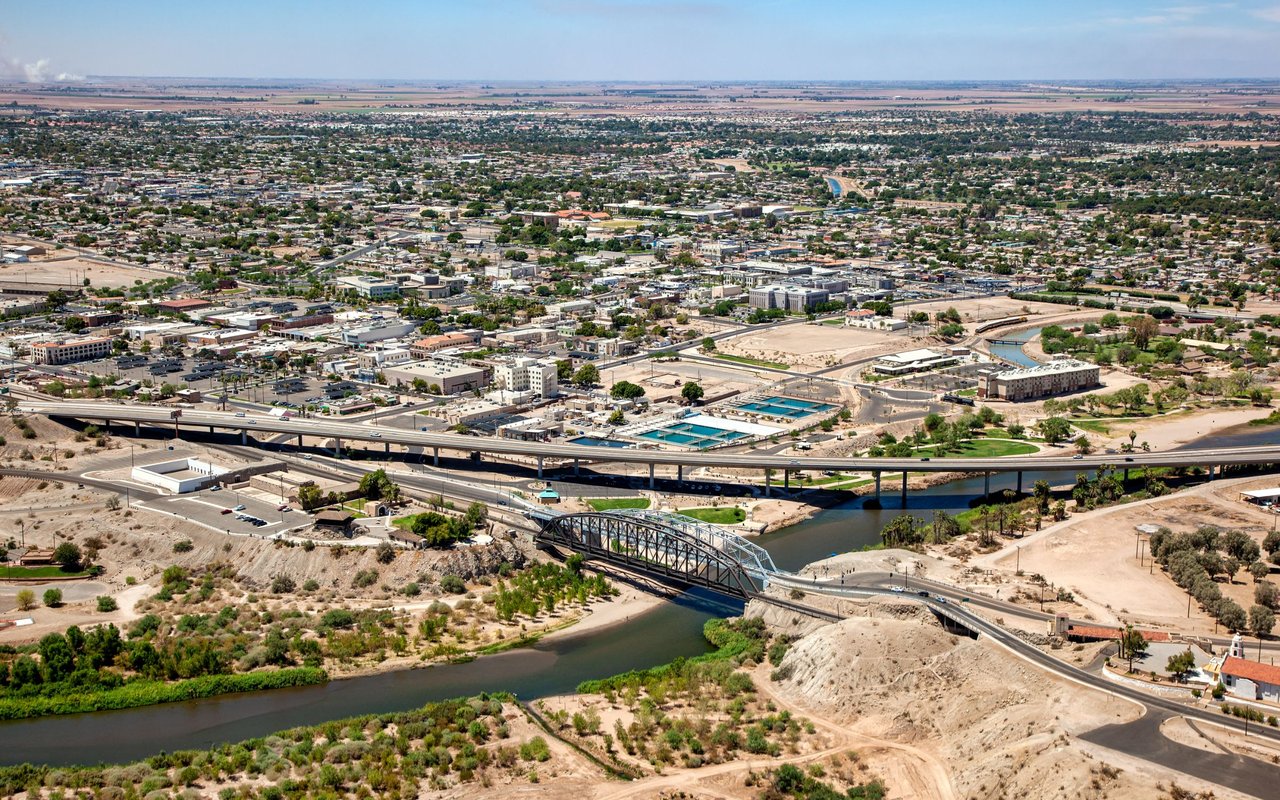
Drive out to the Yuma Mesa before 7 a.m. this week and you will smell it before you see it. Muslin bags rustle on fifteen-foot palms. Crews on hydraulic lifts reach into the fronds, tying off heavy bundles of fruit before the day's heat turns the work into something closer to survival. By nine, the temperature is already past 100, and the same sun that sends most residents indoors is the reason the fruit ripening overhead is considered some of the best in the world.
The visitor season and the harvest season do not fully line up: the October-through-May stretch when tour buses roll up and gift shops are stocked is largely after harvest. If you want to see actual date farming in Yuma, you have to show up in the heat you're trying to avoid.
The Two Date Seasons Yuma Runs Together
Most Yuma date farms open their doors to visitors from roughly October through May, which happens to line up with the winter population swell and the mild weather everyone actually wants to be outside in. But the fruit is picked, bagged, and packed during a separate harvest period that begins before the visitor season. One traveler who booked a farm tour after Thanksgiving found the grounds nearly silent, with only the gift shop open, because harvest had already wrapped by then. The mismatch is baked into how the season gets marketed.
| Harvest Window (Late Aug – Oct) | Visitor Season (Oct – May) | |
|---|---|---|
| What's happening | Hand-picking, bagging, sorting, packing | Retail, tastings, scheduled tours |
| Weather | Triple digits, often into the teens past 100 | Mild, 70s to low 90s |
| Farm activity | Crews on lifts, harvest crews on-site daily | Quieter, seasonal staff, tour-dependent |
| Best for | Watching the actual work, buying fresh off the crop | Comfortable tours, gift shopping, tastings |
If you've ever pulled into a date farm parking lot in December expecting to see harvest activity and found a quiet gift shop instead, this table is why.
Why This Year Arrived Early
The 2026 season pulled its own schedule forward. Farmers reported that the intense early heat pushed pollination up by about a month compared to a typical year, which meant fruit matured faster and harvest activity started ahead of the usual late-summer timeline. Nels Rogers, a second-generation farmer at Martha's Gardens, told AZFamily that the heat is a feature and not a bug for this particular crop: "the dates thrive in the weather, they thrive in this hundred degree weather."
Rogers has watched the operation grow from roughly 300 to 400 starter trees to about 10,000 producing Medjool palms across a 160-acre spread, a scale that reflects how much the local industry has expanded over three decades. The compressed 2026 timeline means the harvest, which normally runs into September, was already well underway by late August this year, not just starting.
What's Actually Ripening on Yuma's Farms Right Now
A handful of named operations make up the working core of this season, each with a different footprint:
- Martha's Gardens Date Farm, on Avenue 9 3/4 E on the Yuma Mesa, is the Rogers family's roughly 160-acre operation and the most visible harvest site for locals who want to watch the process, sample dates fresh off the crop, and pick up a date shake at the farm store.
- Naked Dates, out in Wellton on Avenue 25E, runs organic Medjool acreage and sells date beer alongside its shakes, a detail that separates it from the more tourist-facing stops.
- The Peanut Patch, on County 13th Street, is smaller and retail-focused, known locally for its date shakes and homemade fudge rather than working farm tours.
- Imperial Date Gardens, technically across the state line in Bard, California, but functionally part of the same Yuma Mesa and Bard Valley growing region, ships fresh-crop Medjools starting in September and has been expanding its Somerton-area acreage for years.
- Bard Date Company, whose crews were bagging and tying fruit bundles through mid-July this year in preparation for a harvest window that manager Dave Mansheim expected to run from late August through the end of October.
That last detail matters if you're trying to time a visit. The harvest is not a single weekend. It starts with the earlier Barhi variety and winds down with Medjools, with timing varying by farm.
The Economic Weight Behind the Date Shake
It's easy to treat this as a quaint agritourism detail, a stop on the way to somewhere else. The scale says otherwise. Yuma-area date production runs around 10 million pounds a year, a $30 to $35 million industry that employs more than 2,000 people annually, according to figures compiled by the local tourism bureau. That is a meaningful chunk of local economic activity concentrated almost entirely into the harvest window that most residents spend avoiding the outdoors entirely.
Put another way: while much of Yuma treats late August and early September as the dead zone before the snowbird season fills back up, date farms are running at peak labor intensity, with harvest crews doing specialized work that includes pollination follow-up, de-thorning, tying, bagging, and hand-picking fruit that cannot be mechanically harvested. The visitor economy and the harvest economy are, quite literally, running on opposite clocks.
The Backstory Behind Every Bag of Yuma Medjools
There's a reason Yuma growers talk about their dates with more pride than you'd expect for a shake ingredient. In 1927, a fungal disease called bayoud started wiping out Medjool date palms in Morocco. Eleven palm offshoots were shipped to the United States and quarantined for years before nine surviving plants were released to growers in the Southwest, with cuttings eventually planted in the Bard Valley in the 1940s. Years later, trees grown from that original stock were sent back to Morocco to help replenish groves that had been devastated by the same disease that nearly wiped out the variety altogether.
That means the Medjool dates ripening on Yuma Mesa trees this week descend from the same rescued lineage that helped restock the fruit's country of origin. It's a detail most people driving past a date farm on their way to Costco have never heard, and it's part of why local growers describe their crop less like produce and more like preserved history.
If You Want to See This Season Before It Closes
A few ways to catch the actual working harvest rather than the quieter aftermath:
- Go before the weather breaks, not after. The working season is happening now. Waiting for cooler weather may mean arriving after the crews have moved on.
- Call ahead if you want a tour. Several farms only run scheduled walkthroughs with a minimum group size, and farm activity during harvest can make staff harder to reach for booking.
- Watch Yuma's event listings for La Cosecha del Dátil, a local date harvest gathering that shows up on the September calendar most years, if you want a public event built around the season rather than a farm visit.
- Buy directly from the source while the crop is fresh. Farm stores sell dates picked within days, not the shelf-stable product that shows up in grocery stores months later.
None of this requires planning a vacation. It requires resetting the assumption that "date season" means the comfortable months, when the actual work, and the freshest fruit, belongs to the harvest window, when everyone else is trying to stay out of the sun.
Yuma rewards the people who know its rhythms past the obvious ones, whether that's a harvest window hiding in plain sight or a neighborhood worth understanding before you commit to it. If you're weighing a move to the area and want someone who reads Yuma at that level of detail, the Fontanes Real Estate Team can walk you through it property by property. Get Your Instant Home Valuation and start the conversation whenever you're ready.