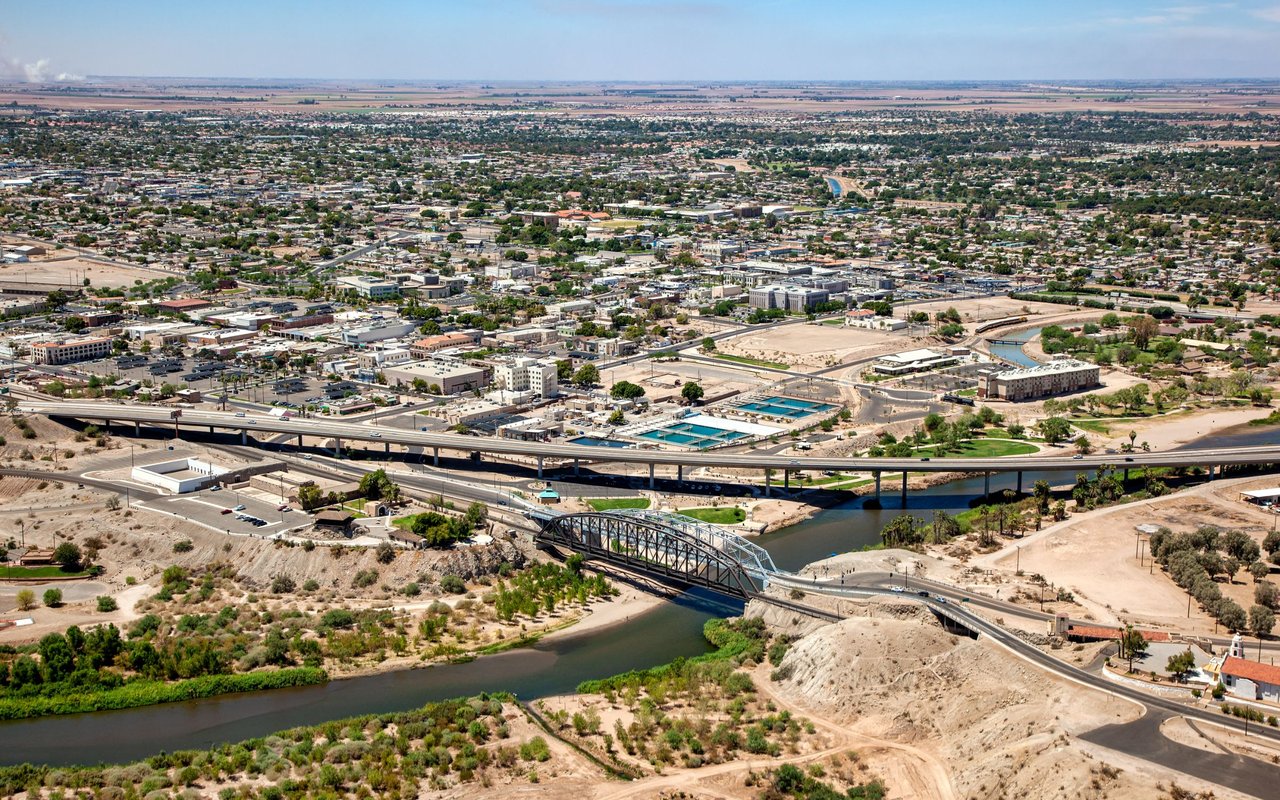
The Colorado River has run under new federal operating rules since October 1, 2026. Their first-year cut to the Lower Basin is the deepest the region has faced. Arizona gives up the largest share. Most of that cut falls on the Central Arizona Project, the canal system serving Phoenix and Tucson. Yuma diverts river water directly, and the farm economy around the city faces questions beyond this year's headlines.
Water supply has also drawn attention to new construction, household water bills and the fights City Hall has chosen to take on.
What Took Effect on October 1
The Bureau of Reclamation published its Final Environmental Impact Statement on July 31, 2026. A Record of Decision followed on August 21. It adopted a 2027 to 2036 Decision Framework and separate operating guidelines for 2027 and 2028. The seven Basin States never reached consensus, and the new operations had to begin October 1, 2026, with or without a deal.
According to Reclamation's August 21 announcement, Lake Mead deliveries to the Lower Basin drop by 1.25 million acre-feet in calendar 2027. Reclamation's October 15, 2026 24-Month Study confirms that a shortage condition governs Lake Mead in 2027. Under the sharing plan the three Lower Basin states proposed, Arizona's annual reduction for 2027 and 2028 is 760,000 acre-feet. AZFamily reported that the Central Arizona Project faces a 50% cut.
Two years of specific numbers are on the table. The ten-year framework leaves shortage volumes and state-by-state splits for later operating guidelines. That gap between 2028 and 2029 matters for Yuma, as the rest of this post shows.
Water Supply and New Construction
New construction brings water supply into focus. Yuma and metro Phoenix are in different systems.
The Arizona Department of Water Resources lists the City of Yuma as a provider with a designation of adequate water supply, outside the state's Active Management Areas. ADWR defines "adequate" as enough water of suitable quality continuously available for at least 100 years. ADWR's designated provider list is dated August 26, 2025.
Metro Phoenix has worked under a much tighter rule since 2023. In June of that year, the Governor's Office announced that the Phoenix AMA groundwater model projected 4.86 million acre-feet of demand going unmet over 100 years. According to ADWR's Phoenix AMA groundwater supply updates, the agency stopped approving new assured water supply determinations there based on groundwater. The state has added workarounds since then:
- An alternative designation rule, effective November 25, 2024, gave providers a gradual path to add alternative supplies while reducing groundwater use.
- The Ag-to-Urban program under SB1611 took effect September 26, 2025, and SB1335 amendments took effect September 12, 2026.
- In June 2026, the Arizona Capitol Times reported that a judge voided ADWR's unmet-demand policy, and the Governor's Office said the state would appeal.
Yuma's River Water Supply
Arizona's 2027 cut lands mostly on the Central Arizona Project. In its March 2, 2026 comments to Reclamation, the City of Yuma described itself as a direct-diversion holder of Priority 1 and Priority 3 contracts. It is entirely dependent on the Colorado River for municipal water and has no viable alternative supply. In the same letter, the city asked Reclamation to preserve priority-based allocations and limit pro-rata reductions.
| City of Yuma | City of Phoenix | |
|---|---|---|
| Colorado River route | Direct diversion, Priority 1 and 3 contracts | About 40% of supply via CAP |
| Other sources | None viable, per the city | About 58% Salt and Verde rivers, about 2% groundwater |
| 2027 exposure | Not CAP; no city-specific 2027 number published | CAP faces a reported 50% cut |
The city's water conservation page puts it plainly. It describes the 2026 Tier 1 shortage and states that "Yuma is not currently subject to CAP reductions." That is the city's most recent posted statement, and it was written about 2026. Reclamation's 2027 announcements give Arizona-wide and CAP-wide figures. They do not set a delivery number for the City of Yuma.
Where the Risk Moved
The Arizona Farm Bureau's August 21 analysis of the final plan used Reclamation's modeling of potential mandatory cuts of up to 3 million acre-feet:
"Yuma irrigation districts with higher third-priority water rights are projected to fare better initially, receiving more than 80% of their appropriations in about half of those years. But they also could face much deeper cuts starting in 2029 that could take more than 40% of Yuma farmland out of production."
That is a modeled forecast, not an allocation. Its timing still lines up with the gap in the federal framework: specific rules through 2028, open questions after. Agriculture carries a lot of weight here. A University of Arizona study published April 2, 2025 found that Yuma agriculture and agribusiness contributed $3.9 billion to the county economy in 2022.
The jobs, payrolls and seasonal demand behind much of Yuma's economy depend on irrigation water.
The Two Fights City Hall Authorized
On September 22, AZFamily reported that the Yuma City Council voted unanimously to authorize legal action on two fronts. The first is a proposed transfer of Colorado River water from GSC Farm in La Paz County to the town of Queen Creek, which Yuma is challenging alongside Mohave and La Paz counties. The second is the federal operating guidelines.
"We get one shot of water, and if that goes away or it's compromised, it can impact our future in a very dramatic way," Mayor Doug Nicholls told AZFamily. He said Yuma needs to be "part of the solution, but not the whole solution," adding that "just turning off the agriculture in Yuma is not the solution." When the story ran, no lawsuit had been filed, and the mayor said the council would keep evaluating its strategy in the coming weeks.
The transfer case concerns rural river water moving to fast-growing suburbs, and the federal case concerns cuts falling on Yuma agriculture. Both target the farm side of the region's water.
What the Household Bill Shows
Inside-city residential rates follow a schedule set under Resolution R2024-007, effective August 1, 2024. The 5/8-inch base charge is $19.47 a month as of August 2026 and rises to $20.06 in August 2027. Usage tiers move from $1.70, $2.00 and $2.29 per hundred cubic feet in 2026 to $1.76, $2.06 and $2.36 in 2027. The increases were adopted two years before the Record of Decision.
Restrictions follow the city's Drought Preparedness and Response Plan. Stage One is a warning with voluntary conservation and changes at city facilities. Stage Two brings mandatory residential measures such as limits on daytime landscape watering. In the first stage of a surface water shortage, the city cuts its own use first. It shortens operating hours for water features and reduces winter grass overseeding.
For a buyer or owner tracking this, a few signals carry more weight than statewide headlines:
- Any city declaration moving Yuma into Stage Two, which is the point where residential watering rules change.
- Formal court filings by the city on the GSC Farm transfer or the federal guidelines.
- The operating guidelines for 2029 and later, where the Farm Bureau's modeled cuts to Yuma's third-priority districts would come in.
- Reclamation's 24-Month Studies, which update the river outlook every month.
FAQ
Does the 2027 shortage cut City of Yuma water deliveries? Reclamation's 2027 figures are set at the Lower Basin, state and CAP level. They do not set a delivery number for the City of Yuma. The city's posted statement says Yuma is not subject to CAP reductions; it was written about 2026.
What is Yuma's water supply designation? The City of Yuma holds an ADWR designation of adequate water supply.
Why does the farm forecast matter to a homeowner? Agriculture contributed $3.9 billion to Yuma County's economy in 2022, and the Farm Bureau's modeling points to possible deeper cuts to Yuma irrigation districts starting in 2029.
This post is general information about public water rules and rates. It is not legal, tax or financial advice, so confirm your own situation with the right professional.
Water is part of the value of every Yuma address, and the Fontanes Real Estate Team follows these rulings as closely as we follow days on market. To see what your home is worth in this market, request your Instant Home Valuation and talk with a team that tracks the river decisions shaping Yuma's economy. Hablamos español.