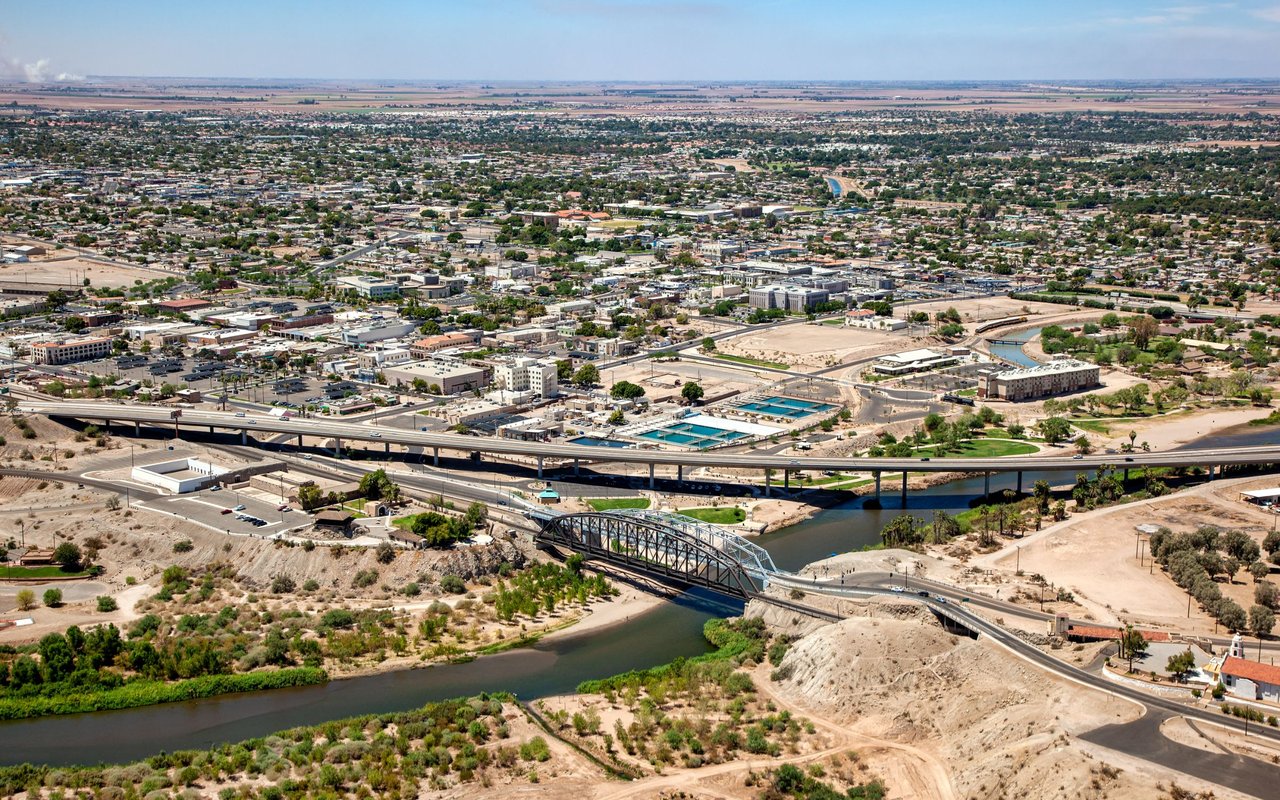
Wondering whether Yuma is a buyer’s market, a seller’s market, or something in between? Right now, the better answer is this: Yuma looks closer to balanced than overheated, which means you need to read more than just one headline number. If you are planning to buy, sell, or invest, understanding a few key signals can help you make smarter moves and avoid costly guesses. Let’s dive in.
What Yuma’s market is saying now
Recent public data points to a market that is active, but not frantic. Redfin’s spring 2026 snapshots showed median sale prices in the low-to-mid $300,000s, with year-over-year price growth and homes taking roughly 76 to 77 days on market. Zillow’s late April 2026 snapshot also showed hundreds of homes for sale and a median sale-to-list ratio near 0.990.
At the same time, Realtor.com labeled Yuma a buyer’s market in February 2026 and a balanced market in March 2026. That shift tells you something important: the market is not frozen, but it is also not moving with the kind of speed that leaves buyers with no options. In practical terms, Yuma appears to be a market where pricing, condition, and timing matter a lot.
Why different numbers can all be true
If you compare Redfin, Zillow, and Realtor.com, you will notice the numbers do not match exactly. That does not automatically mean one source is wrong. It usually means each platform is using a different data pipeline, update schedule, or measurement method.
For example, Redfin says its pricing data comes from MLS and or public records, while Zillow’s home value tools are built from monthly changes in property-level estimates. The best way to read the market is to use one source for your main trend line, then use another source as a cross-check instead of mixing every number together.
Days on market matters more than you think
One of the simplest ways to read the Yuma housing market is to watch days on market, often called DOM. This tells you how long homes are taking to attract an offer or go pending. In Yuma, recent public snapshots showed a typical range from several weeks to a couple of months, not just a few days.
Zillow reported a median of 48 days to pending, Realtor.com reported a median DOM of 56 days, and Redfin showed average DOM around 76 days. Redfin also noted that some hot homes could go pending in about 42 days. The big takeaway is that well-priced homes can still move, but the average listing is not disappearing overnight.
Know the difference between DOM metrics
In Arizona, ARMLS distinguishes between cumulative days on market, or CDOM, and agent days on market, or ADOM. CDOM tracks how long a listing has been live in the MLS overall, while ADOM tracks time with one agent. Both can reset if a listing is cancelled or expired for more than 45 consecutive days and then relisted.
That matters because two listings can look similar on the surface while showing different DOM figures depending on how the data is being counted. Before you compare one property to another, make sure you are looking at the same metric and the same time frame.
What longer DOM can mean
For sellers, a listing that sits longer than the local norm often points to one of three issues: price, condition, or presentation. That does not mean the home will not sell. It means the market may be signaling that buyers are not seeing enough value at the current setup.
For buyers, a property that has been sitting well beyond neighborhood norms may offer room to negotiate. In a market like Yuma, that can be useful leverage, especially when the home has strong potential but needs a pricing adjustment or better positioning.
How to read sale-to-list ratio
Another helpful metric is the sale-to-list ratio. This shows how close homes are closing to their asking price. In Yuma, recent public data clustered around 98% to 99%.
Redfin’s April 2026 figure was 98.2%, Realtor.com’s March 2026 figure was 99%, and Zillow’s March 2026 median sale-to-list ratio was 0.990. In plain language, the typical home is selling slightly below asking price, but not by a wide margin.
What that means for buyers and sellers
If homes are regularly closing at 98% to 99% of list price, buyers may have some negotiating room, but not unlimited leverage. Sellers can still do well when the home is priced correctly and presented clearly. This is one reason balanced markets reward preparation more than guesswork.
It is also worth noting that competitive pockets still exist. Zillow said 16.1% of sales were over list price, and Redfin said 20.2% were over list price. So even in a market that feels more balanced overall, the best-priced homes can still attract strong competition.
Inventory gives you the bigger picture
Inventory tells you how many options are available to buyers and how much competition sellers face. In Yuma, inventory appears to be meaningful and growing compared with last year. That usually points to a market with more breathing room than a low-supply frenzy.
Realtor.com counted 1,290 homes for sale in March 2026, up 10.63% year over year and 4.27% month over month. Zillow counted 856 homes for sale on April 30, 2026, along with 206 new listings. Those totals are different, but they still point in the same direction: buyers have choices, and sellers need a clear strategy.
Citywide data can hide local differences
One of the biggest mistakes you can make is treating all of Yuma the same. Inventory and timing can vary meaningfully by area. Realtor.com’s March 2026 snapshot showed much higher listing counts in places like Foothills and Foothills Mobile Estates than in Mesa del Sol or Yuma East.
Neighborhood timing also varied. Some areas were around 42 days on market, while others were closer to 79 days. That means the real question is not just “What is the Yuma market doing?” but also “What is happening in the part of Yuma where you want to buy or sell?”
Seasonality plays a big role in Yuma
Yuma has a seasonal pattern that is important to understand. The area sees a large winter-visitor population, with public sources noting an additional 80,000 to 100,000 visitors from October through April. During the cooler months, population and activity levels rise in ways that can influence housing demand.
That does not mean every winter month is automatically strong or every summer month is weak. It does mean that in Yuma, month-to-month changes can matter more than they might in a less seasonal market. Buyer traffic and rental demand are likely stronger during the cooler season than during midsummer.
How to use seasonality to your advantage
If you are selling, timing your launch to match stronger seasonal demand may help your listing get more attention. If you are buying, slower periods can sometimes offer more room for negotiation or less pressure from competing buyers. The key is to watch current conditions rather than rely on a one-size-fits-all forecast.
This is where local guidance matters. A citywide headline may tell you the market is balanced, but seasonal shifts can still change how quickly homes move and how much flexibility you have in negotiations.
A simple way to read Yuma like a pro
You do not need to memorize every stat to make a smart decision. You just need a repeatable way to read the market. Start with these four signals:
- Days on market: Are homes moving faster or slower than the local norm?
- Sale-to-list ratio: Are homes closing close to asking price, or are discounts getting bigger?
- Inventory: Are buyers seeing more choices, or is supply tightening?
- Seasonal timing: Is current activity lining up with Yuma’s cooler, busier months or its slower periods?
Then narrow your focus further:
- Compare the property to its immediate area, not just the city average.
- Check whether the DOM figure uses the same method across listings.
- Look at whether the home is priced in line with current market behavior.
- Pay attention to whether well-prepared homes are still moving faster than average.
What buyers should watch in Yuma
If you are buying in Yuma, the current market may offer more flexibility than a true seller-driven market. Homes are not all moving instantly, and sale-to-list ratios suggest that some negotiation can still happen. That said, the most attractive and best-priced homes can still draw quick interest.
Your best move is to compare a home’s time on market with the local neighborhood pattern. A listing that has lingered may present an opportunity. A fresh, well-priced listing in a competitive pocket may require a faster decision.
What sellers should watch in Yuma
If you are selling, the market is still supporting successful sales, but buyers appear to be more selective than they would be in a frenzy. Overpricing can cost you time, and extra time on market can reduce your leverage. In a balanced market, preparation usually wins.
If your home’s DOM starts running above local norms, it may be time to revisit pricing, condition, photos, or launch timing. Sellers who respond quickly to market feedback are often in a stronger position than sellers who wait too long to adjust.
Why context beats headlines
The Yuma housing market is best read as a moving target, not a static label. A headline that says buyer’s market or balanced market can be useful, but it is not enough on its own. What matters most is how DOM, sale-to-list ratio, inventory, and seasonality work together in the specific area and price range you care about.
That is why disciplined local analysis matters so much. When you read the right signals in the right context, you can price smarter, negotiate better, and move with more confidence. If you want help reading your next move in Yuma, connect with Ruben Fontanes for local guidance backed by real market experience.
FAQs
How can you tell if the Yuma housing market is balanced?
- You can look at several signals together, including days on market, sale-to-list ratio, inventory levels, and whether homes are selling slightly below asking price rather than far above it.
What does days on market mean in Yuma real estate?
- Days on market shows how long a home has been listed before going pending or selling, but in Arizona you should also check whether the number is ADOM or CDOM before comparing listings.
Is Yuma a buyer’s market or a seller’s market right now?
- Recent public data suggests Yuma is closer to balanced than overheated, with some sources calling it a buyer’s market earlier in 2026 and a balanced market shortly after.
How much are homes selling for compared with list price in Yuma?
- Recent public snapshots showed sale-to-list ratios around 98% to 99%, which means many homes are closing slightly under asking price while some still sell over list.
Why does seasonality matter in the Yuma housing market?
- Yuma has a large winter-visitor population, so cooler months often bring stronger activity, which can affect buyer traffic, rental demand, and how quickly homes move.
Should you use citywide Yuma housing data for every neighborhood?
- No, because inventory and days on market can vary a lot by area, so neighborhood-level comparisons are usually more helpful than citywide averages alone.